



Assisted reproduction has evolved dramatically over recent decades, transforming what once felt like an uncertain, mysterious process into a carefully structured medical journey grounded in science. For couples exploring these options, understanding what actually happens at each stage, guided by the expertise available at a modern IVF Center, can replace anxiety with clarity and informed confidence.
Many patients enter fertility treatment with limited knowledge of what each stage actually involves, relying instead on secondhand stories or general assumptions. This gap in understanding often creates unnecessary stress and unrealistic expectations. Learning the actual science and sequence behind treatment helps patients feel more in control and better prepared for what lies ahead.
Step One: Comprehensive Baseline Assessment
IVF Doctor guidance during a baseline assessment establishes a clear starting point for both partners before any treatment begins. This evaluation typically includes hormonal testing, structural assessments of reproductive organs, and semen analysis where relevant. This baseline data shapes every subsequent decision, ensuring that treatment protocols are tailored to the specific factors affecting each individual case rather than following a generic template.
Step Two: Ovarian Stimulation and Monitoring
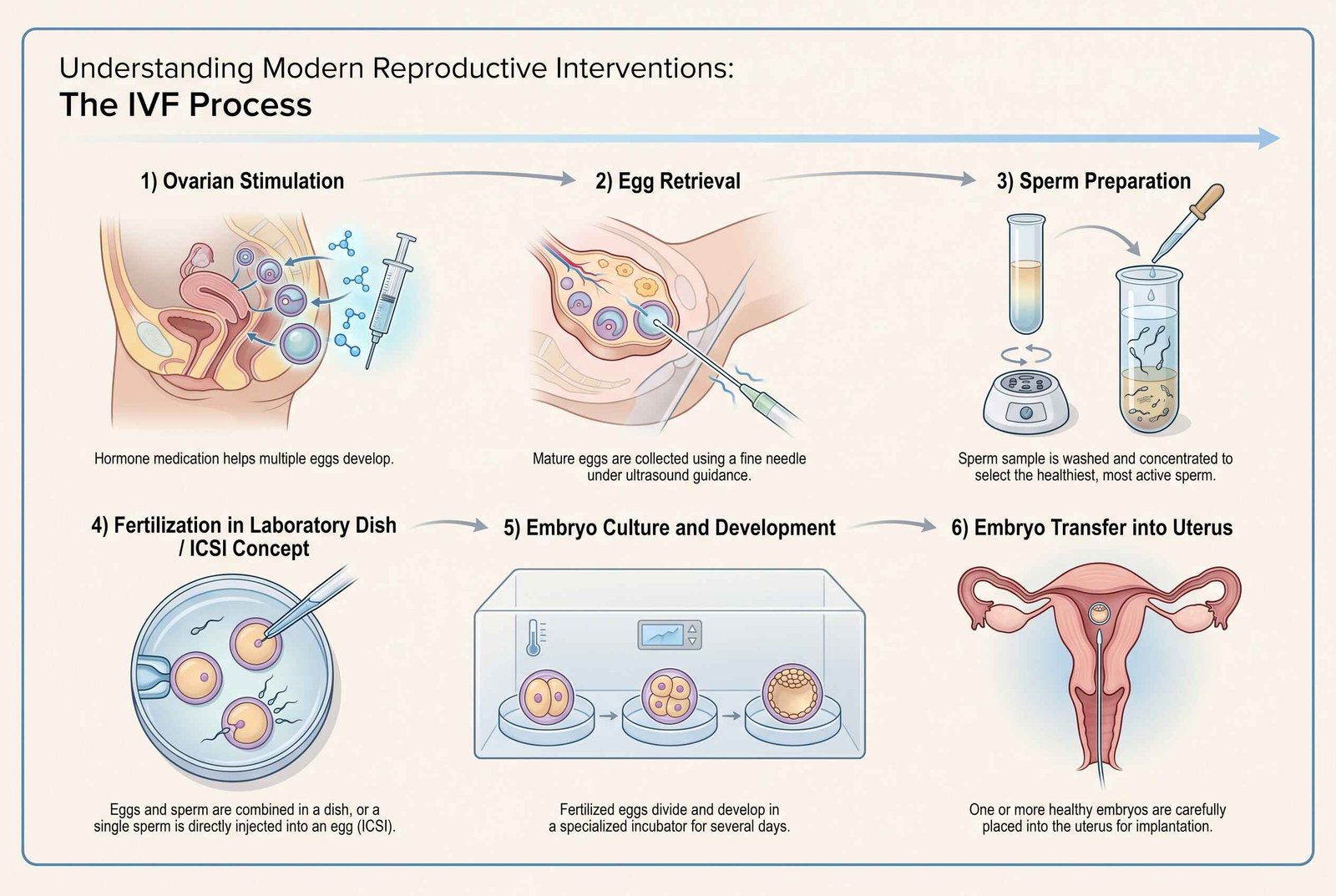
Once baseline testing is complete, controlled ovarian stimulation begins, using medications designed to encourage the development of multiple mature eggs rather than the single egg typically released in a natural cycle. Throughout this phase, regular monitoring through blood tests and ultrasounds tracks follicle growth and hormone levels, allowing adjustments to medication dosing as needed to optimize outcomes while minimizing risks.
Stimulation protocols must be carefully individualized, since two patients with different hormonal profiles may require entirely different medication approaches. A specialist’s ability to interpret monitoring data accurately often determines how well this phase progresses toward a successful outcome
Step Three: Egg Retrieval
When monitoring indicates that follicles have reached appropriate maturity, a retrieval procedure collects the eggs directly from the ovaries. This is typically performed under sedation and involves a relatively quick recovery period. The number and quality of eggs retrieved depend on multiple factors, including age, ovarian reserve, and how the body responded to stimulation medications.
Step Four: Laboratory Fertilization
Following retrieval, eggs are combined with sperm in a controlled laboratory environment. Depending on specific circumstances, this may involve conventional insemination or a more targeted technique where a single sperm is directly introduced into an egg. The choice between these approaches depends on factors such as sperm quality and previous treatment history.
Step Five: Embryo Development and Monitoring
Fertilized eggs are cultured for several days, during which embryologists monitor development and cell division patterns. Not all fertilized eggs progress successfully to this stage, which is why careful monitoring helps identify embryos with the strongest potential for successful implantation and ongoing development.
| Development Stage | Biological Milestone | Clinical Objective |
| Day 1 (Fertilization) | Pronuclei formation confirmed | Confirms successful gamete fusion |
| Day 3 (Cleavage Stage) | Cell division reaches 6 to 8 cells | Evaluates early embryonic division quality |
| Day 5/6 (Blastocyst Stage) | Formation of inner cell mass and fluid cavity | Optimal stage for selection and transfer |
Step Six: Embryo Transfer
Once embryos reach appropriate developmental milestones, one or more are selected for transfer into the uterus. This procedure is generally quick and doesn’t require anesthesia, though the preparation leading up to it, including uterine lining assessment, plays a significant role in determining the likelihood of successful implantation.
Step Seven: The Waiting Period and Pregnancy Testing
Following transfer, a waiting period of approximately two weeks precedes pregnancy testing. This phase is often described as emotionally challenging, given the uncertainty involved. Understanding that this waiting period is a normal, expected part of the process can help patients manage the emotional weight of this stage more effectively
Why Success Isn’t Guaranteed in Every Cycle
Despite significant scientific advances, assisted reproduction doesn’t guarantee success in a single attempt. Factors such as age, egg and sperm quality, and individual biological variation all influence outcomes. Understanding this reality from the outset helps patients approach treatment with realistic expectations while remaining hopeful about the possibility of success across one or multiple cycles.
How Laboratory Advances Continue Improving Outcomes
Ongoing improvements in laboratory techniques, embryo culture conditions, and selection methods continue to meaningfully improve success rates over time. Patients undergoing treatment today generally benefit from more refined protocols and technology than were available even a decade ago.
The Emotional Journey Alongside the Scientific Process
While the biological process is highly structured, the emotional experience of treatment is often less predictable. Acknowledging this emotional dimension, and seeking appropriate support throughout the journey is just as important as understanding the clinical steps involved.
Conclusion
Modern reproductive interventions follow a carefully structured, science-driven sequence, from initial assessment through stimulation, retrieval, fertilization, and transfer. Understanding each of these stages helps patients approach treatment with greater clarity and realistic expectations, replacing uncertainty with informed confidence throughout what can be a deeply personal and sometimes emotionally demanding journey.
Frequently Asked Questions (FAQs)
Q1: How long does a complete treatment cycle typically take?
A full cycle, from stimulation through pregnancy testing, generally spans several weeks, though timelines vary based on individual protocols.
Q2: Why do not all fertilized eggs become viable embryos?
Natural variation in cell division and development means only some fertilized eggs progress successfully to the transfer stage.
Q3: Is the egg retrieval procedure painful?
The procedure is performed under sedation, making it generally well tolerated with a relatively quick recovery period.
Q4: What happens if the first treatment cycle isn’t successful?
Many patients require more than one cycle to achieve success, and specialists often adjust protocols based on findings from previous attempts.