



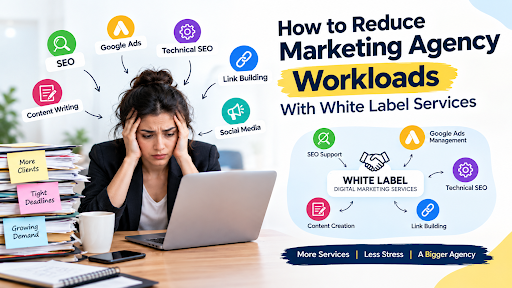
Running a marketing agency sounds exciting until the client list starts growing.
First, you might do it all by yourself. You handle SEO, write and manage content, run Google Ads, and keep up with social posts. You also do the reporting, take client calls, set the plan, and even fix small things on the site. It works when you have a few clients.
Then you get more clients.
Suddenly, your team works late every day. Deadlines start getting closer. Clients ask for more services. Your existing employees have to handle work outside their main skills. You spend more time managing tasks than growing the agency.
This is where many marketing agencies reach a difficult point.
They want to take on more clients, yet they lack enough staff to cover the extra work.
From what I found, outsourcing is now a common fix. Marketing Week said that in 2025, 63.1% of over 3,500 people had used an outside agency in the prior 12 months. The share was 46.2% in the year before.
So, outsourcing is not simply a way to reduce work. It has become part of how many businesses access specialist skills.
For marketing agencies, white label digital marketing agency can offer a similar advantage.
The Problem: Your Agency Has More Work Than Your Team Can Handle
Picture a small digital marketing shop. You have 15 clients. Your team includes two SEO specialists who handle search work. You also have two content writers for blog posts and pages. There is one PPC expert for ads. A project manager keeps everything on track.
Everything looks manageable.
Then three new clients sign contracts.
One wants SEO. Another wants Google Ads. The third wants content, technical SEO, and link building.
You accept all three because you do not want to lose the opportunity.
But your team already has a full workload.
Now your SEO team works extra hours. Your PPC specialist takes on more campaigns. Your writers rush through content. Your project manager spends the entire day following up with different people.
You may win new business, but your workload grows faster than your team.
As per my experience, this is where agency owners often make a mistake. Some teams answer every workload issue by bringing on more full-time staff. Yes, that can make things easier at first. Still, it comes with extra spending.
You have to pay wages. You also spend time and money on hiring. Then there is training. After that, someone has to manage the new people. You may also need software and tools. And you need steady demand so they stay busy all year.
That does not always make financial sense.
The Workload Problem Can Start Affecting Client Results
Heavy workloads do not only affect employees.
They can also affect your clients.
When your team handles too many projects at once, small problems start appearing. Reports may arrive late. Campaign optimization may happen less often. Content revisions may take longer. SEO audits may move to next week.
One delay may not look serious.
But several delays can change how clients see your agency.
A study by Chili Publish says 51% of agencies see tight deadlines as their top problem.
The same study also reports that 43% of agencies miss sales chances because they cannot take on more work.
As I found over research, that second number deserves attention.
An agency may lose new revenue simply because its team does not have enough capacity to take on more work.
That creates a strange situation. You have demand. You have potential clients.But you cannot take them on. Your team already has too much to do.
What Happens When You Keep Doing Everything In-House?
A lot of agency owners think they have to control every service on their own.
I understand that thinking.
You want quality. You want consistency. You want your client to know that your agency handles everything.
But you do not necessarily need to employ every specialist yourself.
For example, you may have an excellent SEO strategist but no dedicated technical SEO team. You may have content writers but no experienced google ads management company. You may know how to plan an SEO campaign but lack a team that can manage large-scale link building.
Instead of turning every service into a full-time department, you can use a white label digital marketing agency.
The white label model allows another specialist team to perform work behind your agency brand. You remain the main point of contact for your client while your partner helps with delivery.
This can give you additional capacity without forcing you to immediately expand your internal team.
White Label Services Can Help You Take More Clients
The biggest advantage I see with white label services is flexibility.
Suppose your agency receives five SEO projects in one month.
Your internal team can handle three.
Instead of rejecting the other two projects, you can use a white label partner to support delivery.
Your agency still manages the client relationship. You can control communication, strategy, pricing, and reporting while your partner handles agreed tasks.
This approach can help you increase your capacity without increasing your permanent headcount at the same speed.
Marketing Week’s 2025 survey also shows that outsourcing is not limited to small companies. The research found that 64.4% of organizations with 250 or more employees had outsourced work to agencies or third parties, compared with 62% of SMEs.
As per data available, this tells me something important: companies of different sizes already use external specialists when internal resources do not meet their needs.
You Can Expand SEO Services Without Building a Larger Team
SEO can feel like a lot of work. It covers many jobs at once.
You may need keyword research first. Then comes content planning. After that, you still handle on page work. There are also technical audits. Competitor analysis is another step. You must manage reporting too. Internal linking can take time. So can link building. Each part asks for its own kind of skill. If your agency mostly does content or simple SEO, you can hit a wall. A client may request a full campaign. You may not have the coverage. That is why white label SEO support matters. It lets you deliver more without building a new team.
You can take on technical SEO services. You can also do local SEO. Plus you can include on page changes, keyword work, and link building.
As per my research, this can also make your agency offer look more complete to clients.
Instead of saying, “We only provide content,” you can position your agency as a marketing partner that manages a wider part of the customer’s growth strategy.
You Can Add Google Ads Without Hiring a Full PPC Department
Paid advertising creates another workload challenge.
You need more than a basic setup for Google Ads. You must pick keywords, choose a bid strategy, write and test ads, set up tracking, watch the budget, and keep improving results over time.
A content writer or SEO specialist does not magically turn into a good PPC manager. The skills do not transfer in a clean way, even if they know how to rank pages.
That is why many agencies bring in other teams. They use specialist support when they need hands on Google Ads work.
One option is a white label PPC partner. They can run the Google Ads tasks while your agency talks with the client.
This can matter even more when the client wants both SEO and paid search at the same time.
Your content team can create landing page copy and ad messaging while the PPC specialist handles campaign performance.
As per my experience, this type of collaboration makes more sense than forcing one employee to learn every part of digital marketing.
White Label Services Can Also Help Your Team Focus
Reducing workload does not mean simply giving work to another company.
The bigger goal involves giving your internal team more time to focus on the work where they create the most value.
HubSpot’s 2025 study reports two things. First, 91% of marketing leaders said their teams use AI to help with day to day tasks. Second, 82% said their firms have put money into automation tools.
So the point is not that tech or outside help should take over your work.
I think of these tools as extra capacity.
That means your team can put more time into planning, talking with clients, generating ideas, and double checking quality.
Meanwhile, outside specialists can run the tasks that repeat a lot or need very specific skills.
The Solution Is Not to Do More Work Yourself
If your agency already struggles with workload, adding more responsibilities to the same employees will not solve the problem.
You need a better delivery model.
White label services can help you build that model.
You can keep your brand, your clients, and your strategy while using specialist teams when your internal capacity reaches its limit.
You can also scale your services based on demand.
If one month brings more SEO projects, you can increase SEO support. If next month adds more pay per click campaigns, you can bring in PPC specialists as needed.
This keeps you from paying for a big full time team when the workload might not stay steady all year.
Build a Bigger Agency Without Making Your Team Bigger
From what I have found, the marketing field is dealing with a few tough shifts. Tech is changing fast, clients expect more each year, and teams are being asked to do extra work with fewer people and less budget. In HubSpot’s 2026 marketing study, leaders said their top worries include tracking ROI, staying on top of new trends, and getting strong leads.
Agencies face the same pressure.
Clients want more services. They want faster results. They want clear reporting. They also want one agency that can solve more of their marketing problems.
You do not have to build a massive internal team to meet every demand.
You can build a strong network of specialist partners.
That is where white label services become useful.
As I found over research, the agencies that manage growth well will not necessarily be the agencies with the biggest teams. Some agencies know how to blend what they already have with tools and outside experts.
If your staff is stuck in long hours, clients want more work all the time, and you keep saying no because you are stretched, it could be time to rethink how you deliver.
You might not need to hire more people.
Sometimes, you simply need more support behind your brand.