



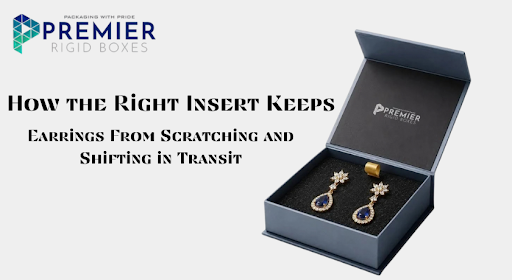
Earrings are small enough that people underestimate how much damage a tiny bit of movement can cause. There’s no real bulk to absorb an impact, no weight holding them down just two small pieces that’ll slide, flip, and knock into whatever’s nearby the second a box gets tilted even slightly. Most of what actually protects earrings during shipping or storage isn’t the outer box at all. It’s whatever they’re sitting in.
Why Earrings Get Damaged So Easily
Compared to most jewelry, earrings don’t have much going for them structurally. They’re light, so they never really settle into one spot on their own. They usually come in pairs, which doubles the odds of two pieces colliding. And a lot of styles carry some delicate feature a thin post, a hook, a stone setting that bends or scratches with barely any pressure at all.
Drop a necklace into a box with too much extra room, and it mostly just tangles. Do the same thing with earrings, and you end up with scratched surfaces, bent posts, or two matching pieces that have rattled against each other long enough to dull a finish that was supposed to stay bright.
What an Insert Is Actually Doing
Strip it down and an insert has one real job: stop the earring from moving at all. That one job ends up solving a handful of separate problems at once.
Position locking comes first; a properly fitted slot holds each earring in place, so nothing slides during handling. This matters much more over a long shipping route than over a short one, since small repeated movements add up over distance and time.
Then there’s keeping the pair apart. If these now-earrings are not tightly packed together, they will touch at some point, and most of the fine scratching will begin there. Each piece is completely separated from its match with a divided tray or separate slots.
Surface cushioning matters too. Foam, velvet, or flocked lining catches the kind of light contact that bare cardboard or plastic just won’t, which is especially important for anything with a polished or plated finish.
And posts and hooks need something to actually anchor into. Left hanging loose, a thin post bends surprisingly easily under even mild pressure from the earring shifting inside its packaging.
What Tends to Go Wrong Without Good Insert Support
- Earrings slide and rattle around in loosely filled packaging, picking up small scratches with every bit of movement
- Paired pieces keep making contact with each other, gradually dulling plated or polished finishes
- Thin posts and hooks bend from unsupported movement, especially with lighter-gauge metal
- Stone settings loosen slowly from repeated vibration and contact during transit
- Pieces shift completely out of position, sometimes tangling with their backing or with each other
A Rough Guide to Insert Types
| Insert Type | Best Suited For | Scratch Protection | Movement Control |
| Foam slot insert | Stud and small drop earrings | Good | Very good |
| Velvet/flocked tray | Statement or finished-metal pieces | Excellent | Good |
| Card-and-post mount | Hook or dangle earrings | Fair | Very good, for posts specifically |
| Molded plastic cavity | High-volume, lower-cost lines | Fair | Good |
| Divided compartment tray | Multi-pair or boxed sets | Good | Excellent, prevents cross-contact |
When Tray and Sleeve Design Work Together
A lot of earring packaging tries to solve presentation and protection as the same problem, and usually one of them loses. Folding earring packaging boxes with tray & sleeve construction sidestep that pretty well the tray does the real work of locking each earring in place and keeping the pair apart, while the sleeve wraps around it for branding and presentation without messing with the tray’s fit at all. Being a folding format also makes it easier to produce at scale without losing precision on the tray, which matters if a brand’s running several earring styles through the same packaging line.
Getting the Fit Right
The worst mistake is to use a single insert size for an entire line of products, instead of making one for each earring’s size. A stud and a long dangle earring will need different depths and shapes of slots, and if squeezed into a general cavity, at least one of them will be under-supported. Brands producing a wide range of styles tend to get more consistent results working with a supplier built around this kind of precision. Premier Rigid Boxes is one example of the sort of supplier earring brands turn to when they need insert accuracy across a varied lineup rather than a single catch-all tray.
FAQs
Do small, lightweight earrings really need custom inserts, or is generic padding good enough?
Custom inserts generally work better. Generic padding still leaves room for small movements that can cause scratching over time, and lightweight earrings are actually more prone to this kind of shifting than heavier jewelry.
Why does it matter if paired earrings touch each other in the box?
Because unseparated earrings make repeated contact during handling, that’s one of the most common causes of fine surface scratching on plated or polished finishes.
Can one insert design handle studs, hooks, and dangle earrings equally well?
Not really. Each shape needs something different. Studs want shallow, snug slots, hooks, and dangles need post support and more vertical room, so one generic insert tends to shortchange at least one of those styles.
Does the insert’s material matter as much as its shape?
They matter for different reasons. Shape controls positioning and movement; materials such as foam, velvet, and flocking control how much surface scratching is prevented. A well-shaped insert in a hard, unlined material can still allow scuffing.
If the tray already protects the earrings, is a sleeve even necessary?
The tray’s job is protection, the sleeve’s job is presentation. Skipping the sleeve doesn’t hurt protection at all, but it does change how the unboxing feels and how the packaging is perceived overall.