



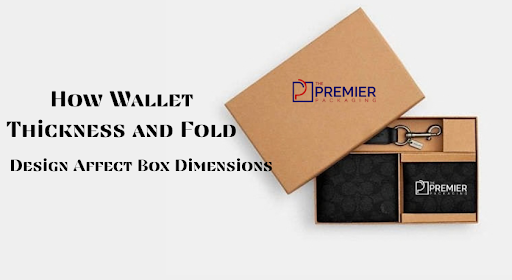
Wallets look like they should be the easiest accessory to small, flat, pretty uniform in shape. Then you actually line up a bifold next to a trifold next to a slim cardholder and realize none of them want the same dimensions at all. Thickness varies by fold type; fold type affects how the wallet sits; and a box built around one style tends to shortchange the others if a brand carries more than one.
Thickness Isn’t Fixed It Depends on the Fold
A flat, empty wallet is almost never the actual shipping condition. Most wallets ship with at least some cards loaded for photography or presentation, and some brands ship them already lightly stuffed to help them hold shape. That means the “thickness” a box needs to account for isn’t the wallet’s thinnest possible state, it’s closer to its realistic, slightly-loaded state, and a lot of sizing mistakes come from measuring the wrong one.
Bifolds add bulk at the center fold, where two leather or fabric layers stack directly on top of each other. Trifolds distribute that bulk across two fold lines instead of one, which usually makes them slightly thinner at any single point but wider overall once unfolded. Slim or cardholder-style wallets barely need extra depth, but they’re more sensitive to being squeezed too tightly, since there’s very little material to absorb pressure.
How Fold Design Changes Box Shape, Not Just Size
Bifold wallets fold into a roughly square shape, and their packaging typically needs to accommodate a slightly thicker spine at the fold. A box that’s sized evenly on all sides, without extra clearance at the fold edge, tends to put pressure exactly where the wallet is already thickest, which, over time, can flatten or crease the leather unevenly.
Trifold wallets are wider when unfolded and foldable at two points instead of one, so their packaging generally needs more width than depth. Boxing a trifold in a box built for a bifold’s proportions usually means the wallet doesn’t sit flat, and an unflat wallet shifts more during transit.
Cardholders and slim wallets need the least internal space of any wallet style, but that doesn’t mean smaller is simpler. Too little clearance and a slim wallet gets compressed at the edges, which, for thinner leather, can set a crease that doesn’t relax back out.
Zip or snap-closure wallets add a small but real dimension problem. The closure hardware itself takes up space, often at a corner or edge, and packaging that doesn’t account for that extra protrusion can put localized pressure right on the hardware.
Wallet Style and Box Dimension Guide
| Wallet Style | Primary Dimension Concern | Fold-Related Risk | Packaging Priority |
| Bifold | Center fold thickness | Crushing at the spine | Clearance at fold edge |
| Trifold | Overall width when unfolded | Uneven lay, shifting | Width over depth |
| Slim/cardholder | Minimal clearance needed | Edge creasing from over-compression | Light, even cushioning |
| Zip/snap closure | Hardware protrusion | Localized pressure on hardware | Space allowance at closure point |
Why Rigid Structure Tends to Solve This Better Than Flexible Boxes
A flexible box can compensate for some thickness variation just by being soft enough to accommodate it, but that flexibility comes at a cost; it also means less consistent protection, since a soft box bends under pressure rather than holding its shape against it. Personalized wallet rigid packaging tends to handle thickness and fold variation better precisely because it doesn’t flex: once the internal dimensions are built around a specific fold style, the rigid shell holds that shape consistently through shipping and storage, rather than slowly deforming around whatever’s inside.
The personalization side embossed detail, a fitted interior cut to the wallet’s exact silhouette, works best layered onto that rigid foundation rather than in place of it, since presentation without structural accuracy still leaves the wallet exposed to the same thickness-related pressure problems.
Measuring for Accurate Box Dimensions
A few habits catch most dimension mistakes before they reach production:
- Measure the wallet in its realistic shipping state, not completely flat and empty
- Measure thickness at its actual thickest point — usually the fold — not an average across the wallet
- Account for hardware protrusions separately from the wallet’s base dimensions
- Build slightly more clearance at fold lines than at flat sections, since folds are where thickness concentrates
- Test with the actual product rather than relying purely on spec sheet numbers, since small manufacturing variations between units can shift real-world fit
Brands producing wallets across several fold styles often find it worth working with an established supplier for this kind of fold-specific sizing, something like the premier packaging, for instance, rather than trying to standardize a single box dimension across bifolds, trifolds, and slim styles that genuinely need different internal proportions.
Final Words
Wallet packaging looks simple from the outside, but the fold design quietly decides almost everything about what a box actually needs, where it should be thicker, where it should flex less, and where a closure needs its own bit of room to breathe. Getting those dimensions right, fold by fold rather than guessing from one generic template, is really what separates a wallet that arrives looking exactly as it left the workshop from one that shows up slightly creased, pressed, or out of shape before it’s even been used.
FAQs
Should wallet boxes be measured against an empty or a loaded wallet?
Generally, the realistic shipping condition is lightly loaded if that’s how the product ships, since an empty measurement often underestimates the actual thickness the box needs to accommodate.
Why do trifold wallets need different box proportions than bifolds?
Trifolds spread their bulk across two fold lines and end up wider when unfolded, while bifolds concentrate thickness at a single center fold — the two shapes just don’t fit the same box dimensions well.
Does closure hardware really affect box sizing?
Yes, more than people usually expect. Snaps, zippers, or clasps add a protrusion that needs its own clearance, and ignoring it tends to put ongoing pressure directly on the hardware.
Is rigid packaging necessary for every wallet style, or just higher-end ones?
Rigid packaging helps most wallet styles hold their shape and avoid pressure damage, but it matters most for higher-end leather pieces, where scuffing and creasing are more visible and more costly to repair.
Can one box size reasonably cover bifold, trifold, and slim wallet styles?
Not well. Each style has different thickness and width needs tied to how it folds, so a single shared box size usually ends up either too tight for one style or too loose for another.