



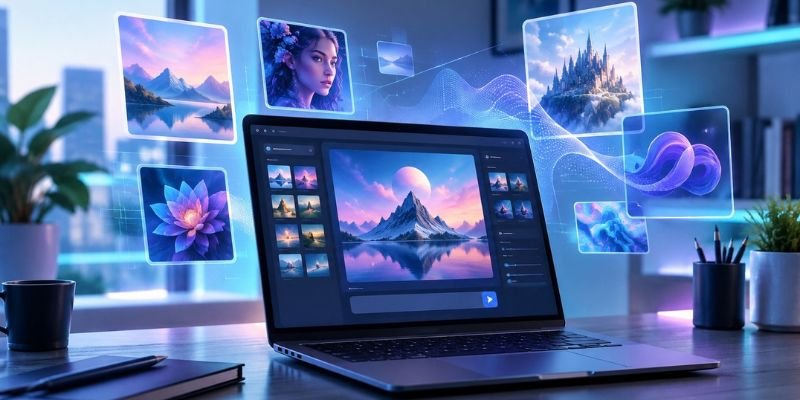
Visual communication has always played an important role in the digital world. From blog illustrations and social media posts to advertising campaigns and presentation graphics, images can often communicate an idea faster than several paragraphs of text.
Creating those visuals, however, traditionally required photography, graphic-design skills, stock-image subscriptions, or a significant amount of editing time. Artificial intelligence is beginning to change that process. Modern image-generation tools can turn written descriptions into original visual concepts in seconds, giving creators new ways to experiment with ideas before investing time in full production.
This shift does not mean traditional design is disappearing. Instead, AI is becoming another tool in the creative workflow—one that can help people move more quickly from an idea to a usable visual.
Table of Contents
ToggleFrom Written Prompt to Visual Concept
At the center of AI image generation is a relatively simple interaction: the user describes what they want to see, and the system interprets the description to create an image.
A prompt might describe a futuristic city at sunset, a minimalist product background, an editorial-style illustration, or a detailed fantasy environment. The quality of the result depends not only on the underlying AI model but also on how clearly the user communicates the idea.
For example, someone using an AI image generator from text can describe the subject, setting, lighting, composition, mood, and visual style rather than beginning with an empty design canvas. The generated image then becomes a starting point that can be refined, edited, or regenerated.
This changes the earliest stage of visual creation. Instead of spending most of the initial effort producing an image, creators can spend more time exploring different concepts.
Why Prompt Writing Is Becoming a Creative Skill
AI image generation may look automatic, but useful results still depend heavily on human direction.
Short prompts such as “a modern office” leave many decisions to the system. More specific prompts provide greater creative control. A creator might instead request a bright contemporary office photographed from a wide angle, with natural morning light, neutral furniture, indoor plants, and a clean editorial aesthetic.
That additional detail helps define the intended visual language.
Several prompt elements can influence the final result, including the subject, environment, perspective, lighting, color atmosphere, level of realism, composition, and artistic style. Learning how these elements interact is quickly becoming part of the modern content-creation skill set.
In many ways, prompting is similar to giving instructions to a photographer or designer. The creator still needs a clear concept; AI simply changes the method used to communicate it.
Faster Visual Experimentation
One of the most practical benefits of generative imagery is speed during the concept-development stage.
A marketing team preparing a campaign may want to explore several visual directions before choosing one. A blogger may need a distinctive concept for a featured image. A small business may want to test different advertising ideas without producing a complete photo shoot for every variation.
AI makes this kind of experimentation easier because several visual directions can be explored quickly.
The first generated result does not have to be the final image. It can function as a draft, mood board, reference, or creative prototype. Creators can compare different compositions and styles, identify what works, and continue refining the strongest direction.
That iterative process can be more valuable than simply generating one image and immediately publishing it.
More Capable Models Are Expanding Creative Possibilities
The technology behind AI-generated images continues to develop. Newer systems are becoming better at understanding detailed instructions, handling complex scenes, and translating natural-language descriptions into coherent visuals.
Tools built around models such as GPT Image 2.5 demonstrate how image creation is increasingly becoming part of a broader AI-assisted creative workflow. Rather than treating image generation as an isolated task, creators can use AI while developing concepts, revising visual directions, experimenting with compositions, and preparing assets for other content formats.
As these systems improve, the most important distinction may no longer be whether an image was created with AI. What matters more is whether the visual communicates the intended message effectively.
AI Can Support More Than Social Media Graphics
Generative images are sometimes associated mainly with eye-catching social posts, but their applications are much broader.
Publishers can use generated visuals to illustrate abstract topics that are difficult to photograph. Educators can create visual examples for lessons and presentations. Designers can develop early concepts before producing polished assets. Video creators can generate backgrounds, references, or storyboard ideas. Entrepreneurs can visualize product concepts before committing to expensive production.
AI can also be helpful when a subject requires a conceptual image rather than a literal photograph.
An article about cybersecurity, for example, may benefit from a carefully designed conceptual illustration instead of another generic photograph of a laptop. Similarly, an article about future cities or emerging technology may require imagery that does not yet exist in the real world.
Generative tools give creators more flexibility in these situations.
Human Judgment Still Matters
Fast image generation does not remove the need for creative judgment.
AI can produce a technically impressive image that is still inappropriate for the intended audience. Details may be distracting, the tone may not match the brand, or the composition may not work well with surrounding text.
Every generated image should therefore be reviewed carefully.
Creators should check whether the image accurately communicates the intended idea, whether important details appear natural, and whether the visual fits the platform where it will be published. They should also consider copyright, disclosure, and usage requirements that may apply to a particular project or publishing environment.
The ability to generate content quickly makes editorial review more important, not less important.
The Best Results Often Come From a Hybrid Workflow
The most effective use of AI does not necessarily involve replacing existing creative tools.
A stronger workflow may combine several approaches. AI can generate an initial concept, while traditional editing software can handle cropping, typography, branding, color adjustments, and final layout. Photographers can use generated concepts as references. Designers can use AI outputs as inspiration rather than finished work.
This hybrid approach allows creators to benefit from automation while maintaining human control over quality and communication.
It also reduces the pressure to obtain a perfect image from a single prompt. The AI output becomes one stage of the process rather than the entire process.
Visual Creativity Is Becoming More Accessible
Perhaps the most significant change is that visual experimentation is becoming available to a much wider group of people.
Previously, turning an imaginative idea into a convincing visual often required specialized software and years of technical experience. Those skills remain valuable, particularly for professional design, but AI lowers the barrier to early-stage creation.
A writer can illustrate an article concept. A student can visualize an idea for a presentation. A small company can explore campaign concepts. A content creator can develop visual references without beginning every project from scratch.
The technology does not automatically make someone a strong designer. It does, however, make it easier to participate in the creative process.
What Comes Next for AI-Assisted Creativity?
AI-generated imagery is likely to become increasingly integrated into everyday creative software rather than remaining a separate category of technology.
The important question for creators will be how to use these capabilities thoughtfully. Generating more images is easy; creating visuals that are relevant, distinctive, and appropriate still requires intention.
Successful creators will likely combine strong ideas, clear prompting, careful editing, and human judgment. AI can accelerate production and broaden creative possibilities, but the underlying purpose of visual communication remains unchanged: the image must help the audience understand, feel, or notice something.
As AI tools continue to develop, the creative advantage will not simply belong to the people who generate the most content. It will belong to those who know how to turn new technology into meaningful visual communication.